In the Clan is Strength
The Amazing Maurice and His Educated RodentsIn the Clan is Strength is the first Thought Peaches records for The Clan, turning an idea about collective survival into a principle the rats can preserve, debate, and put into practice. Its meaning develops beyond simple strength in numbers: the story contrasts a frightened crowd that loses its capacity to think together with a community whose members share knowledge and act in concert.
Formulating and preserving the Thought
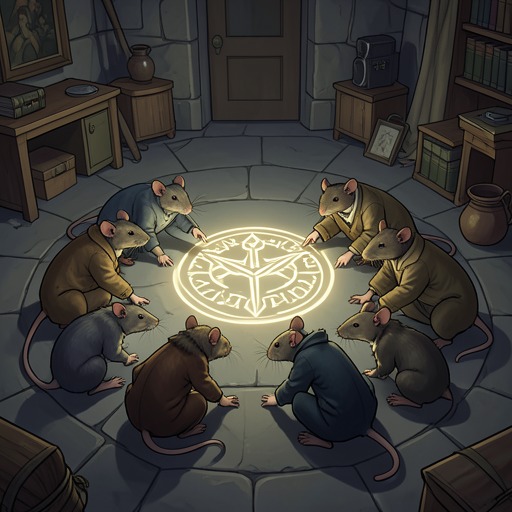
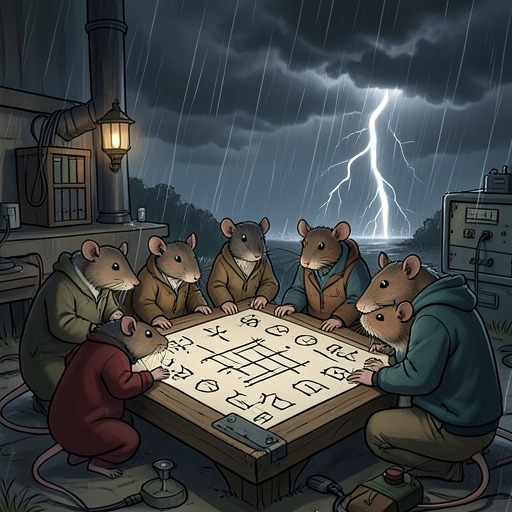
The phrase begins a written list of the rats’ Thoughts. Peaches works to make human writing intelligible to rats, who generally find its lines and marks difficult to read. To express the first Thought visually, she tries to draw one large rat made from many smaller rats. The image gives the abstract claim a communal form: the whole is made of its members, rather than replacing them.
The Thought belongs to a wider effort to preserve knowledge beyond any one rat’s lifetime. Dangerous Beans argues that writing allows what a rat knows to remain available after that rat has died, so others can learn it. Hamnpork resists the proposal: he has spent years acquiring his own skills and does not want younger rats to receive that knowledge without the same struggle. Dangerous Beans answers with the next Thought, We co-operate, or we die. The difficulty of translating cooperation does not make the idea remote; Peaches can recognize it in rats guiding a blind or wounded companion. Together, the two Thoughts connect shared strength to the sharing of both practical knowledge and immediate help.
Individual thought, panic, and coordination
The plot tests the principle against the difference between individuals and crowds. Maurice explains that rats can think and show courage individually, yet a mass of frightened rats may become a panicked mob, reacting to one another’s fear instead of making considered choices. When terror spreads among the rats, some run past Peaches and Dangerous Beans in confusion; Dangerous Beans notices that they have forgotten how to talk. The scene shows collective life breaking down at the level of language as well as coordinated action.
Darktan later addresses a frightened squad by naming what distinguishes its members: they are rats with brains who can think and resist the impulse to run. His appeal recasts the group not as an animal carried along by shared panic, but as members capable of choosing a common purpose. In a later fight, the Clan moves together in a line, closing ranks when attacked; when fear disrupts that formation, its members change their tactics and pursue the threat in pairs. The contrast makes the Thought practical: being many is not enough. Strength depends on members keeping enough discipline and mutual purpose to act together.
Cooperation versus domination
Dangerous Beans’s encounter with Spider exposes a false version of cooperation. Spider offers a partnership that would let them rule the rat world together, but Dangerous Beans recognizes that the proposed alliance means power for its leaders and mass death for other rats. He tests Spider’s assumptions by asking what one of the hypnotized rats thinks. Spider cannot see why an ordinary rat’s thoughts should matter; Dangerous Beans concludes that the plan would not work. The exchange sets shared strength against domination: an arrangement that treats its members as disposable cannot count as the cooperation expressed in the Clan’s Thoughts.
From a shared principle to an accord
The principle also informs the possibility of human-rat coexistence in Bad Blintz. Keith urges the Mayor to talk with the rats rather than rely on force, warning that driving them away would not prevent them from returning. Darktan presents negotiation as an opportunity, not a threat. When the Mayor asks why the rats did not poison wells or set fires, Darktan answers in terms of consequences: killing humans would solve nothing, since the rats would still have to deal with people somewhere, sooner or later. The resulting discussions require a contract and a committee, not merely a hopeful gesture. In that ending, collective strength is not a claim that the rats can simply defeat or rule others; it gives them the capacity to refuse needless harm and negotiate a future together.